As capital markets evolve, the definition of real assets is expanding beyond the ground. Space-enabled infrastructure is emerging as a new class of resilient, data-driven assets; linking sustainability, security, and long-term value creation for institutional investors.
Infrastructure Beyond Earth: The Next Frontier of Real Assets
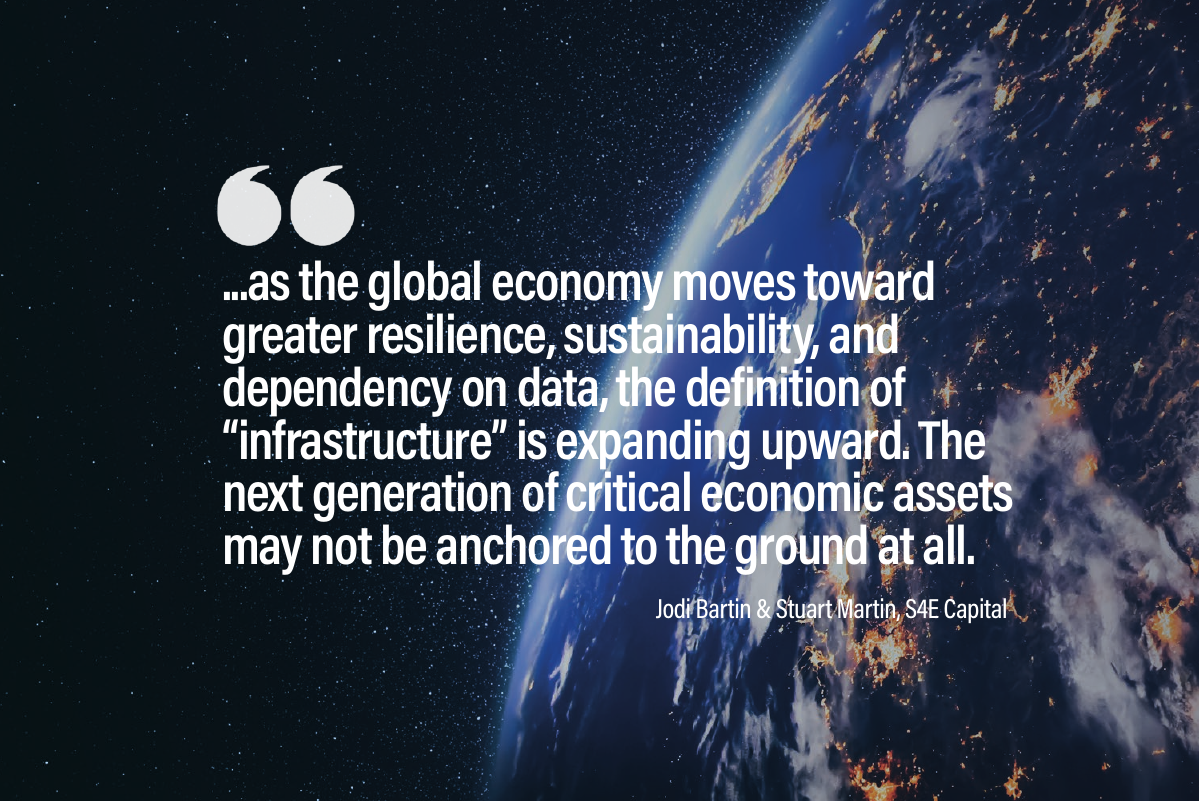
Infrastructure investing has always been about tangible assets with enduring demand; roads, ports, grids, pipelines. Very “down to Earth”, one might say - essential but unglamorous. Yet, as the global economy moves toward greater resilience, sustainability, and dependency on data, the definition of “infrastructure” is expanding upward. The next generation of critical economic assets may not be anchored to the ground at all.
Space-enabled infrastructure is rapidly becoming as indispensable to modern economies as energy networks or railways. A new generation of satellites, including Elon Musk’s Starlink, is forming the backbone of 21st century communication networks. Constellations of navigation and Earth-observing spacecraft are quietly underpinning agriculture, climate adaptation, energy efficiency, and logistics. These aren’t speculative science projects. They are sound commercial propositions, and they are happening now.
The New Global Infrastructure
Consider the value chain behind a single data point: soil moisture in Kenya, methane emissions in the Persian Gulf, or vessel congestion at the Port of Singapore. Increasingly, that intelligence originates hundreds of kilometres above Earth. Satellites are now data utilities, delivering the real-time visibility that governments, insurers, and supply chains rely on.
In effect, orbital infrastructure has become the connective tissue of global commerce. And like traditional real assets, it offers long-term contracts, stable returns, and defensible barriers to entry. Sovereigns, corporates, and investors are waking up to the fact that space-based infrastructure is not an exotic asset class, it’s an essential one.
What’s more, this trend is only set to continue. Plans are already underway to locate a new generation of data centres, high-value manufacturing plants, and even energy production facilities in space. A new era of asset-rich, off-world commerce is just around the corner.
Impact With Orbit
For investors seeking measurable impact, space infrastructure is a force multiplier. It’s enabling deforestation monitoring, carbon accounting, clean energy integration, and disaster-response strategies at planetary scale. These aren’t abstract benefits; they are quantifiable, auditable, and increasingly demanded by regulators and LPs alike.
Crucially, this is dual-use infrastructure: it enhances national resilience (defence, communications, security) while advancing sustainability goals. In a capital market fatigued by vague ESG narratives, this combination of utility and impact is compelling.
Rethinking Real Assets
Traditional valuation models struggle with assets that appreciate through network effects rather than depreciation schedules. A bridge loses value over time; a satellite constellation gains utility with every new data partnership. That inversion challenges how investors categorise “core” and “growth.”
It also invites longer duration, mission-aligned capital; a hybrid of infrastructure and venture finance that’s beginning to take shape through new funds and public-private collaborations.
Infrastructure That Looks Up
In a decade defined by climate volatility and digital interdependence, infrastructure’s ultimate test is adaptability. The assets that matter most won’t just move goods or electrons, they will move information and secure resilience.
The infrastructure of the future may orbit, but its purpose remains grounded: to connect, protect, and sustain life on Earth. The smart capital is already adjusting its trajectory accordingly.